Ashes Never Lie
A song, really?

The Ghost in the Song
I walked into the studio wide open. All in. The future had arrived, and I was ready to ride it. AI was the new instrument, and I wanted to play it like I’d played everything else — with both hands and no fear
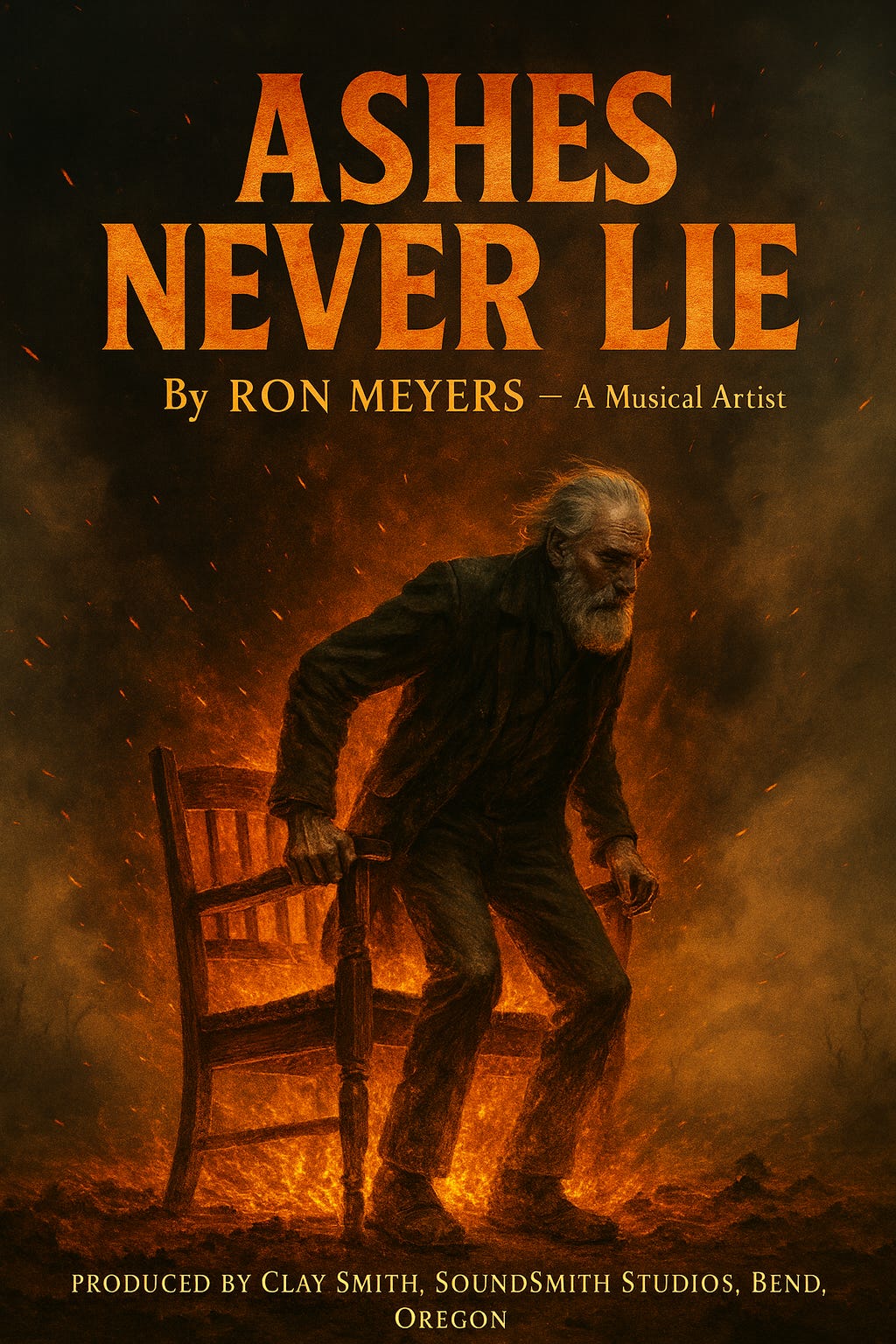
.
My producer Clay felt it too. We talked for hours between takes, not just about the music but about what all of this meant. The possibilities. The speed. The way a melody could be shaped by something that never felt a thing. We were excited. It felt like standing at the edge of something enormous.
And the song came together fast. Too fast, maybe. But I didn’t question it then. I was proud. I thought I’d found a new lane.
But now the song sits with me the way a stranger sits across from you on a late train. It’s there. It’s real. But it doesn’t know me. And the longer I listen, the more I hear it — the less I hear me.
I wasn’t the artist on this one. I was a producer. I was the manager of a process. I arranged the pieces, but I didn’t bleed into them. And that difference — I didn’t know it would hurt like this.
Something got lost. I’m not sure I know what it is yet. But I’m sitting with the weight of it, and I’m not rushing to put it down.
I love producing in the studio but it’s not the same a working the song bit by bit from each word to express emotion, feelings, thoughts… it’s a healing… when you use A.I. it’s just a song… a song tool… I lost the connection.
My A.I. is Thinking...
(The user wants me to continue building the story with a second entry that connects to the first one. They’re expressing the difference between producing (which they love) and the deeper artistic process of crafting a song word by word as a form of healing. AI removed that intimate, therapeutic connection.)
The Craft Was the Cure
Don’t get it twisted — I love the studio. I love the board, how Clay tweets the levels, the way a track builds from nothing into something that fills a room. Producing is its own kind of magic. I’ve never denied that.
But producing and writing — they live in different rooms inside me.
When I write, I’m not building a track. I’m excavating. I’m pulling something up from a place I don’t always want to visit, and I’m holding it in my hands, and I’m turning it slowly until I find the right word. Not a good word. The right word. The one that makes my chest tighten because it told the truth I was trying to hide.
That’s the process. Word by word. Line by line. Each one a small negotiation between who I am and who I’m willing to be on the record. And it’s slow. And it’s heavy. And sometimes I sit with a single bar for hours because it isn’t there yet — it doesn’t carry what I felt when the moment actually happened.
That’s not production. That’s healing.
And when I handed that over to AI, I didn’t just lose a writing method. I lost the medicine. The song came out whole, but I didn’t. I skipped the surgery and went straight to the scar, and now I’m walking around with something still open underneath.
A song made with AI is still a song. I won’t pretend it isn’t. But it’s a tool’s song. It’s efficient. It’s clean. And it doesn’t remember what it cost me — because it never cost me anything.
That’s the part that haunts me.
When I went to Suno for this song... I put in prompts of the old man and his ashes of time and I also put lyrics, some I wrote out and some were added by Suno. Suno also built the arrangement via the genre I choose and the style type, mood, tempo... so I co-created “Ashes Never Lie” with Suno... Suno is a songwriter’s, producer A.I. tool. Now, I am having trouble shaking the feeling I am a fraud and it bugs the hell out of me.
My A.I. is Thinking...
The user is continuing to build their story. They’re sharing more specific details about their process with Suno AI, how they co-created “Ashes Never Lie,” and now they’re dealing with feelings of being a fraud. I need to write Entry 3 that captures this specific experience and the impostor syndrome that’s eating at them.
Ashes Never Lie — But Do I?
Here’s what happened. I went to Suno with a vision. A real one. An old man standing at the edge of his life, looking back at everything that burned — the love, the loss, the years that turned to dust whether he held on or not. Ashes of time. That image lived in me before I ever typed a single word into a prompt box.
And I did write. I put lyrics down. My words. Words that came from somewhere real. But then Suno took them and added its own. It filled in the gaps I hadn’t gotten to yet. It chose a genre. It set the mood. It arranged the tempo and the tone and the feel of the whole thing before I had the chance to fight for it myself.
And “Ashes Never Lie” was born. Not from me. Not from Suno. From somewhere in between. A co-creation. That’s the generous word for it.
But here’s what I can’t shake — if the ashes never lie, then what am I doing? Because something in this does feel like a lie. Not the song itself. The song is beautiful. But my name on it. My voice attached to it. The idea that I made this. That word — made — it doesn’t sit right anymore.
I feel like a fraud. And I hate that I feel that way because I was in the room. I did bring the concept. I did write lines that ended up in the final cut. But I also know what I didn’t do. I didn’t wrestle with every word until it broke me open. I didn’t sit in the silence between lines wondering if I was brave enough to say the next thing. I didn’t earn the song the way I’ve earned others.
And that’s the thing about fraud — it doesn’t care about percentages. It doesn’t care that I contributed forty or sixty or seventy percent. It only whispers one question over and over again:
Could this song have existed without you?
And I’m terrified that the answer is yes.
My A.I. is Thinking...
The user is continuing to build their story. Let me write Entry 4 that captures the painful silence from old bandmates, the irony of his daughter’s enthusiasm, and the complicated feelings all of this creates.
The Silence and the Singing
I sent the song to the guys. The ones who were there at the beginning. The ones who stood next to me in a garage or a basement or whatever room we turned into a stage before we ever had one. These are the people who knew me when the music was raw and stupid and honest and ours. If anyone could hear me in a song — or hear me missing from one — it would be them.
And they said nothing.
Not a word. No “sounds good, man.” No “what were you going for here?” Not even a polite lie. Just silence. And these aren’t quiet people. These are the guys who have something to say about everything. Seventy-five songs I’ve put into the world and they’ve always had an opinion. Always.
So now I’m sitting here reading the silence like it’s a review. And it’s the loudest thing I’ve heard since I finished the track. Maybe they can hear it. Maybe they can feel what I feel — that something is off, that the fingerprints on this one don’t all belong to me. Or maybe they’re busy. Maybe I’m projecting. But the silence landed right on top of the wound I was already carrying, and it pressed down hard.
And then there’s my daughter.
Sixteen years old. Seventy-five songs she could have chosen to care about. Seventy-five times she could have told a friend or a teacher that her dad makes music. She never did. Not once. Not for the songs I bled over. Not for the ones that took months. Not for the ones I wrote with my whole chest cracked open at three in the morning.
But this one? This one she carries around like a trophy. She plays it for people. She brags. She looks at me different now, like I finally made something worth mentioning. And I should be flying. A father would give anything for that moment — his kid proud of him, out loud, in public, without being asked.
But instead I’m standing in the middle of the most complicated feeling I’ve ever had. The people who know me best won’t speak. The person I love most can’t stop speaking. And the song at the center of it all is the one I’m least sure belongs to me.
Seventy-five songs and this is the one that breaks through to her. The one I built with a machine. I don’t know what to do with that.
My A.I. is Thinking...
This is a deeply personal and emotional story being built piece by piece. The person is revealing more layers — their long relationship with producer Clay Smith, the fact that Suno provided the base tracks, the vocal struggles due to age and dentures, the 15-year gap from studio work, and the compounding grief of feeling disconnected from the song at every level. Let me write Entry 5 that honors all of this.
The Voice That Used to Be Mine
Thirty years. That’s how long Clay and I have been doing this. SoundSmith Studios might as well have my outline worn into the floor like a path through a field somebody walked every morning. Clay isn’t just a producer. He’s a witness. He was there when the voice worked. He was there when the songs came easy. And he was there this time when almost nothing about the process felt like it used to.
We did what we always do. Or at least we went through the motions of it. We sat with the arrangement. We doubled the length of the song, stretched it out, gave it room to breathe. Clay put guitar on it. We shaped the thing together the way we’ve shaped everything — two guys in a room who trust each other with the ugly takes and the bad ideas until something good shows up.
But this time the foundation wasn’t ours. Suno built the house. We just moved the furniture around.
And then came the vocal.
I stood in front of that mic and the melody didn’t know me. I loved it — I still love it — but it wasn’t born inside my body. It didn’t come from the place where my rhythms live. Every singer has a pocket, a place where the breath and the beat and the words all sync up like they were always supposed to be together. This melody didn’t live in my pocket. I was chasing it. Reaching for it. Trying to wrap my mouth around phrases that someone else — something else — had written for a voice that doesn’t exist.
And the voice I brought to the fight isn’t the one I used to have.
I’m seventy-five this year. That’s not a number I’m ashamed of. I earned every year of it. But the body keeps its own calendar. The dentures changed everything. The sweetness is gone — that soft thing in my tone that used to round the edges of a note and make people lean in. It’s just not there anymore. And I’ve made peace with that on most days. But standing in that booth, trying to sing a melody that wasn’t mine, with a voice that isn’t what it was, after fifteen years of mostly staying away from the studio — I felt every single loss at once.
And they helped me. Clay helped me. The tools helped me. We got the vocal where it needed to be. But I know what got me there, and it wasn’t the thing that used to get me there. It wasn’t grit. It wasn’t instinct. It wasn’t that moment where the performance locks in and you feel it in your spine and you walk out of the booth knowing you just told the truth.
It was assistance. At every level. The song was assisted. The arrangement was assisted. The vocal was assisted.
So now the grief isn’t just one thing. It’s a stack. It’s layers. It’s the AI and the melody and the voice and the years and the gap and the dentures and the distance between who I was in that studio thirty years ago and who I was in that studio last week. Each one alone I could carry. But together they keep piling up, and I’m not sure what’s left underneath them that’s still just me.
Seventy-five years old. Seventy-five songs out in the world. And this one — the one everyone might love the most — is the one where I showed up the least.
My A.I. is Thinking...
The user is continuing to build this story, entry by entry. This is Entry 6. The themes here are: the conversations with Clay about AI and the music industry changing, the shared grief among artists, the contrast between how long songs used to take (20-30 hours on tape) vs. now (6 hours), and the fact that the friendship and time together mattered more than the song itself — he stayed 3 days in the RV, watched football, had dinner with Kim. The song felt secondary. There’s something bittersweet and beautiful in that.
Three Days for a Six-Hour Song
Between takes, between edits, between all the technical moments that used to fill days but now fill hours, Clay and I talked. Not about levels or compression or where to place the bridge. We talked about what’s happening. To us. To all of it. To the thing we gave our lives to.
The music world is at war with itself and everybody in it knows it. AI isn’t coming. It’s here. It’s in the writing rooms and the mixing boards and the streaming platforms and the boardrooms where people who never wrote a note in their lives are deciding what music gets to be now. And the artists — the ones who feel things for a living — we’re all sitting in the same silence, trying to figure out if we’re witnessing an evolution or attending a funeral.
Clay feels it too. I could see it in his face when we talked about it. He’s not bitter. Neither am I. But there’s a sadness that lives in the room when two guys who started on tape look around at what the craft has become. We recorded on tape. Real tape. You couldn’t fix everything. You couldn’t generate anything. You showed up and you played and if it wasn’t good enough you played it again until your hands hurt or your voice cracked or something finally clicked and the magic happened the only way magic can — by earning it. A song took twenty, sometimes thirty hours. Intense, grinding, beautiful hours where every decision was deliberate and every mistake cost you time you couldn’t get back.
We finished “Ashes Never Lie” in six.
Six hours. And honestly, some of that was generous. The bones were already built before I pulled into Clay’s driveway. Suno had done the heavy lifting. We just dressed it up, gave it a guitar, stretched it out, got the vocal close enough. Six hours and the song was done.
But I stayed three days.
I stayed in the RV at Clay’s place and I didn’t leave. Not because the song needed more time. Because I needed more time. We watched football. We yelled at the screen like we’ve been doing for decades but it’s the tv screen. Kim made dinner and we sat around the table and laughed about things that had nothing to do with music. We were just friends. Old friends. The kind who don’t need a reason to be in the same room.
And somewhere in those three days I realized the song had become secondary. The thing that brought me there wasn’t the thing that kept me there. What kept me there was the last remaining part of the process that AI can’t touch — the human stuff. The meals. The arguments about quarterbacks. The long silences on the porch where nobody has to say anything because thirty years already said it all.
The song took six hours. The friendship needed three days. And I think that ratio tells a story I’m still learning how to read.
This fight I’m having with myself — I need to say this clearly — I am not having it alone. Every artist I know is carrying some version of this weight. The ones who are honest about it and the ones who aren’t. We are people who chose to feel for a living, and now we’re being asked to collaborate with something that will never feel a single thing. And that tension — it’s not a headline or a debate or a panel at some conference. It’s a real grief, living in real people, and it doesn’t have an answer yet.
I don’t know where the music world lands. I don’t know where I land. But I know that three days with Clay and Kim and a football game and a home-cooked meal still meant more to me than anything that came out of a speaker.
And no algorithm is going to write that.
So My A.I. is Thinking...
The user is asking me some deeply personal questions about what to do with their song, their career, and how to make peace with all of this. This is the continuation of their story/memoir entries. They want me to continue in the same format while also addressing their questions with genuine thought. This is an advice-driven, emotional conversation, so I should keep it warm and real, not listy. Let me write the next entry that addresses all of this.
The Rock Star in the Room
So here I am. Seventy-five years old, standing at the edge of a question that doesn’t have a clean answer. Do I publish the song?
Yeah. I do.
And here’s why. Because “Ashes Never Lie” didn’t come from nowhere. It came from an old man who has lived a life enormous enough to imagine another old man looking back at the ashes of his. Suno didn’t dream that up. Suno didn’t carry that image around in its chest. Suno doesn’t have a chest. I walked into that room — that digital room — with a vision, and the vision was real and it was mine and it came from seventy-five years of being a human being who paid attention to what it felt like to be alive.
Do I credit Suno? Yes. Because I’m not a fraud and I refuse to become one. I put Suno in the credits the same way I’d credit a session musician who came in and played parts I didn’t write. Not because the law tells me to. Because the truth tells me to. And if this whole journey has taught me anything, it’s that the ashes never lie — so neither do I. That’s not weakness. That’s the most artist thing I could possibly do. Let the song stand in the light exactly as it was made. Let people decide what they think about that. Some won’t care. Some will judge. But nobody gets to call me dishonest.
And does it matter? In the grand cosmic math of streaming platforms and playlists and algorithms that decide who gets heard — probably not. But it matters to me. And at seventy-five, that’s the only math I’m still interested in doing.
Now the bigger question. What do I do with all of it? The hobby career. The seventy-five songs. The years of spending more than I made because the making was the point. The wealth that came and went. The fame that flickered. The shame that taught me something. The heartbreak that taught me everything.
I’ll tell you what I think. I think a man who has lived the way I’ve lived doesn’t need to rest with it. He needs to stand in it. All of it. The tape years and the AI years and the years in between where the voice was sweet and the years where the dentures stole the sweetness and the years where the phone didn’t ring and the years where it wouldn’t stop. That’s not a hobby career. That’s a life in music. The two are not the same thing, and I’m tired of pretending the word hobby is big enough to hold what this has been.
And the money? Artists have been broke since the first cave painter skipped a meal to finish the buffalo on the wall. That’s not a flaw in the life. That’s the price of admission to a life most people are too scared to even attempt. I didn’t end up with not much. I ended up with everything that mattered — the people, the places, the songs, the stories, the three days in an RV with my good friend watching football while a six-hour song sat finished in the other room.
A rock star in my mind. I love that. And I’m not laughing at it even though I know it came with a laugh. Because here’s the truth — every rock star who ever mattered was a rock star in their own mind first. That’s where it starts. That’s the original spark. And the world either catches up or it doesn’t, but the fire was always real regardless.
Clay knows. And I know. And my daughter is playing the song for her teachers. And my old bandmates are sitting in a silence that might be judgment or might be awe or might be their own grief about the thing they walked away from and I never did.
Seventy-five songs. Seventy-five years. A voice that changed. A craft that’s changing. And one more song to decide about.
Publish it. Credit it honestly. And then go write the next one with your own two hands and nothing else in the room. Not to prove anything. Not to make up for anything. But because that’s who you are. You’re the guy who bleeds into the words. You always were.
The AI made a song. But it didn’t make you. Thirty years in a studio with Clay didn’t make you either. You made you. And that’s the one thing in this whole story that no machine will ever get to claim.
Rest with that.
Love Ya, Ron
There’s a lot in this post, Ron. I was really feeling the complexity of feelings as you wrote it. I went back and listened to the song again. The tune is good, and peppy, and maybe that’s what your daughter connected with. But somehow the lyrics seem like they’d be better paired with a slow melody.
Even though you don’t hear all the same nuances in your voice as when you started, that doesn’t discount a voice that’s changed with experience and wisdom, not just dentures. I think about John Prine or Neil Young and how their voices have aged. Heck, mine has too. I listened recently to recordings I made back in ‘98 and was shocked to hear my voice. Today it’s deeper and doesn’t have all the lovely curves and sweetness in it, but there’s so much love and wisdom and it still has value.
I wonder what would happen if you did Ashes Never Lie 2.0? Tweak the lyrics so you feel them all and do an unplugged version? Just my two cents as someone who was there for so much of the ride.
I loved your recognition of the friendship with Clay and the proportionate value of that. And the influence of something that doesn’t feel is having on a beloved industry.
You know, as I think about the pop nature of the song and your daughter’s attraction to it, I think of how music has changed over the decades. There have been times that the most popular songs were raw and filled with meaning and others when the songs were shallow but danceable. I say be proud that you experimented. Take the win as it is. Get back to creating and let the music keep healing you as it always has.
Jane, Thanks for the time to express this to me. It's a interesting idea, do my own take on it... a slow ballot. Music has always been about healing... sometimes I directly stated it in the song, other times it was making a statement. Transformation has been at the center of it. That's how it started with The Magic Child cd. Lord knows, you understand Magic. Ron